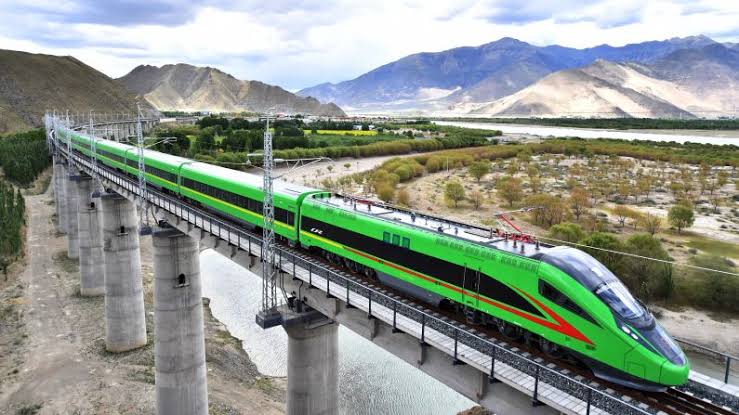

China is developing a high-speed train for the future with a target speed of 1,000 km/h, which would significantly exceed the speed of traditional jet aircraft..
The Japanese SCMaglev L0 series, which reaches a speed of 603 km/h, was until recently the undisputed leader in the field of train speeds. But now the Chinese competitor, T-Flight, has achieved speeds of 20 km/h larger, thus pushing the Japanese carrier to second place.

The T-Flight project, developed by CASIC, is based on hyperloop technology, once patronised by Elon Musk. The tests of the Chinese train are carried out in a special tube approximately 2 km long, located in northern China.

To achieve such high speeds, designers had to minimise friction. Therefore, the test track was made with extraordinary precision – the plane deviation over a length of 2 km is only 0.3 mm, and in the case of a 6-meter diametre, deviations of up to 2 mm were maintained.
Nevertheless, CASIC has greater ambitions. They believe their train can reach a speed of 1,000 km/h, which would exceed the speed of passenger jets, which fly at an average speed of over 900 km/h. To achieve this, they plan to build a new 60-kilometer test track.
CASIC does not even rule out the possibility of reaching a speed of 2,000 km/h, which would enable an express connection between Beijing and the city of Wuhan. But will the technology being developed make it possible to implement such ambitious plans? Time will tell