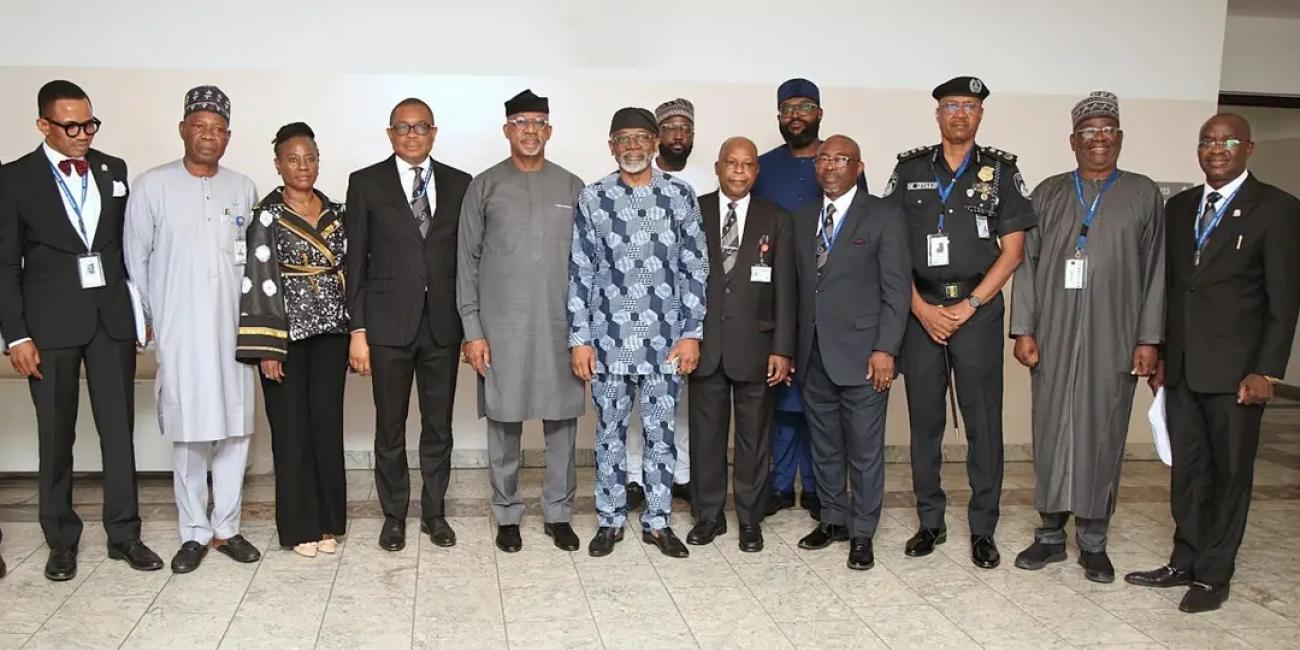


Marking another milestone towards establishing a dual policing structure, comprising the Federal Police Service and 36 State Police Services, President Bola Tinubu has inaugurated the Presidential Working Group on the National Policing Bill to prepare the legal framework for the implementation of state police across Nigeria.
Tinubu, who was represented by his Chief of Staff, Femi Gbajabiamila, inaugurated the committee on Tuesday at the Presidential Villa in Abuja.
The development follows the passage by the National Assembly of the Constitution Alteration (State Police) Bill, 2026, which proposes a constitutional framework for the establishment of state police across the federation.
According to a statement issued by the President’s Special Adviser on Information and Strategy, Bayo Onanuga, while the constitutional amendment creates the legal foundation for state police, the National Policing Bill will provide the operational framework required for its implementation.
“The Constitution Amendment Bill establishes the framework for dual policing, but it does not operationalise it. That work is left to the National Policing Bill,” President Tinubu said.
The President explained that the proposed legislation would address critical issues required for the smooth implementation of state policing nationwide.
According to him, the National Policing Bill will contain provisions covering minimum policing standards, state readiness certification, federal-state coordination, accountability mechanisms, human rights safeguards and fiscal conditions necessary for the effective operation of state police services.
Tinubu said the committee had been specifically constituted to ensure that an implementation-ready draft of the legislation would be completed immediately after the constitutional amendment process.
“The Working Group has been constituted to produce a technically robust, implementation-ready draft National Policing Bill for transmission to the National Assembly,” the President said.
He added that the committee was established to prevent unnecessary delays once the constitutional amendment establishing state police is completed.
“We must not wait until the constitutional process is concluded before beginning this important assignment,” Tinubu said.
Gbajabiamila will serve as chairman of the Presidential Working Group.
Other members of the committee include the Attorney-General of the Federation, the President of the Nigerian Bar Association (NBA), the Chairman of the Nigeria Governors’ Forum (NGF), the National Security Adviser, the Inspector-General of Police, the Chairman of the NGF Committee on State Police, while a secretariat will provide administrative support for the committee.
Speaking on behalf of the Nigeria Governors’ Forum, Dapo Abiodun pledged the support of state governors towards the speedy implementation of the reform.
Abiodun disclosed that the 36 state governors were prepared to accelerate work on the constitutional amendment once it is transmitted to their various State Houses of Assembly for ratification.
According to him, the introduction of state police responds to Nigerians’ long-standing demand for community-based policing.
“This bill has answered the cries of Nigerians about cascading policing and removing it from the Exclusive Legislative List,” Abiodun said.
The Ogun State governor also said the initiative validates the effectiveness of regional security outfits such as Western Nigeria Security Network (Amotekun) operating in the South-West.
He further argued that state police would substantially strengthen Nigeria’s security architecture by significantly increasing the number of security personnel across the country.
“If each state deploys about 6,000 personnel, we will add nearly 200,000 officers to complement the existing federal police,” Abiodun said.
He commended President Tinubu for commencing implementation planning before the constitutional amendment process had been concluded.
“This inauguration demonstrates the proactiveness of the Executive in preparing for effective implementation,” he added.
Also speaking, Lateef Fagbemi, the Attorney-General of the Federation and Minister of Justice, described the initiative as timely considering Nigeria’s current security challenges.
“There is no denying the fact that we are in a critical moment security-wise, and all hands must be on deck,” Fagbemi said.
The Attorney-General also appealed to state governors to facilitate the speedy ratification of the constitutional amendment by their respective State Houses of Assembly.
“I appeal to the governors to do their utmost to ensure the early passage of the constitutional amendment because this is a shared responsibility,” he said.
The President of the Nigerian Bar Association, Afam Osigwe, reaffirmed the NBA’s support for the establishment of state police, arguing that Nigeria’s security realities require decentralised policing.
“Nigeria can hardly be effectively policed by one national police. We fully support the constitutional amendment providing for state police,” Osigwe said.
He, however, cautioned against the possible abuse of state policing powers, insisting that the enabling law must contain adequate safeguards to protect citizens’ rights.
“We must ensure we do not create a monster. The right legal framework must guarantee accountability and prevent oppression,” he said.
Osigwe pledged the NBA’s commitment to supporting the committee in producing legislation that would strengthen national security while safeguarding constitutional rights and preventing abuse.